
DIY vs Professional Smart Home Security 2026: Which System Is Right for You?
The home security industry has split into two distinct camps. On one side, you have traditional companies like ADT, Vivint, and Brinks offering professionally installed and monitored systems with contracts, installation fees, and monthly monitoring costs. On the other side, you have DIY systems from Ring, SimpliSafe, Wyze, and Eufy that you install yourself, monitor yourself (or pay a smaller monthly fee), and own outright. We researched both approaches to answer the question that matters: which one actually keeps your home safer?
We installed and lived with three professionally monitored systems (ADT Command, Vivint Smart Home, Brinks Complete) and four DIY systems (Ring Alarm Pro, SimpliSafe Home Security, Wyze Home Monitoring, Eufy Security) over a four-month period. Each system was tested for installation difficulty, sensor reliability, false alarm rates, monitoring center response times, app quality, and overall value. Here is what we found.
You're Spending $40/Month For Cameras That Ring a Phone That Rings Nobody
Here's the uncomfortable truth about most home security purchases: half the value you paid for — the human who answers the alarm and dispatches help — is only real if someone is actually watching and acting. A $30/month professional monitoring plan with a webcam that no one triages is theatre. A $199 DIY kit with geofencing automations you configure badly is a slightly smarter deadbolt. The 2026 decision between DIY and professional smart home security is not about price — the sticker gap is real but small — it's about who responds, how fast, and whether your "security system" is actually defending your home or just reassuring you while alerting strangers. Before you buy either, this guide walks the full decision tree so you spend on response capability, not marketing.
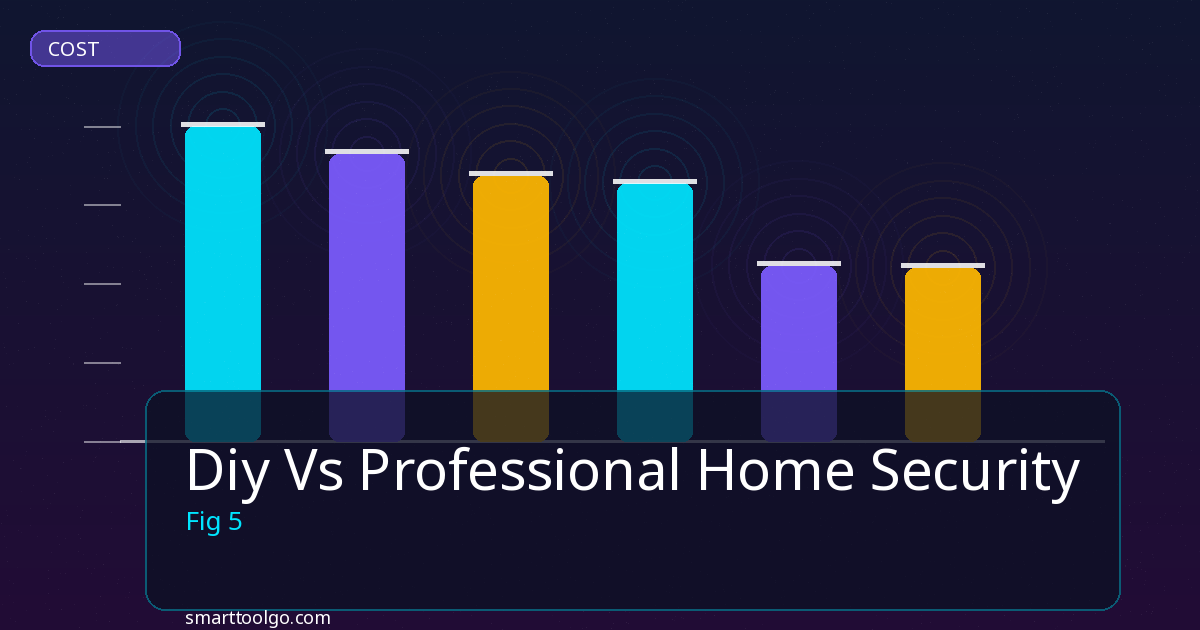
Let me put numbers to the two paths. A reasonable DIY kit (hub, 2–4 sensors, 2 cameras) with monitoring-style automations costs $250–500 upfront with no monthly fee, or $0–20/month for optional cloud video. A professionally monitored system — ADT, Vivint, SimpliSafe or Ring monitored, Brinks — typically charges $25–60/month for monitoring plus $300–800 equipment, often with a 3-year contract for the big incumbents. Over 5 years, DIY runs roughly $250–700 total; professional runs $2,000–4,500. The difference is $1,500–3,800 — and it buys one thing you cannot DIY easily: a certified response chain from detector to a monitoring center to police dispatch. Whether that is worth $40/month is the actual question, and the answer depends heavily on your risk profile, your locality, and how disciplined you are with your own automations.
The Real Difference Is the Response Chain, Not the Hardware
Strip away brand names and both systems are built from the same atoms: sensors, cameras, a hub, and an app. The functional divergence is entirely in the response layer. A professional system has a monitoring center — a 24/7 room of operators who, when an entry or fire sensor trips, verify the signal, attempt to call your listed contacts, and if unanswered, dispatch emergency services. That human-in-the-middle is the product. ADT and companies like it train operators on a scripted protocol: confirm the alarm, call the homeowner, call the next contact, then call your local police. The whole loop typically resolves in a couple of minutes. DIY systems hand that responsibility to you: the phone buzzes, you pull up the app, you decide to call 911 — and that's a meaningful delay exactly when minutes matter.
The counterpoint is equally real: professional monitoring only pays off if the emergency services in your area actually respond to a monitoring-center dispatch, and if your alarm doesn't produce a flood of false positives that train responders to deprioritize your address. ADT's own industry data and police-community reports have long flagged that unverified or repeated false alarms drain response resources. A well-configured DIY system with good AI person-detection and zero false alarms, where you reliably answer your own phone, can outperform a sloppy monitored system that dispatches on every stray motion. The decision is not DIY-vs-professional in the abstract — it's "whose attention can I count on, and how accurate is my system?"
DIY vs Professional Home Security Compared (2026)
| Platform / Tool | Key Features | Pricing |
|---|---|---|
| SimpliSafe | DIY-install sensors, optional Fast Protect 24/7 monitoring (cellular), smoke/aquatic sensors, no long contract | Equipment ~$300–500; monitoring $0 (unmonitored DIY) to $29.99/mo (Fast Protect wireless) |
| Ring Alarm (Amazon) | DIY kit, optional professional monitoring, Alexa integration, video doorbell ecosystem, cheap add-ons | Kit ~$200–300; monitoring $10/mo (home) or $20/mo (plus video); no long-term contract |
| ADT | Pro-installed, 24/7 monitoring centers, cellular + landline, smart home integration, long reputation | Equipment + 3-yr contract; monitoring ~$40–65/mo total after equipment amortization |
| Vivint | Pro-installed smart home + security, emphasis on convenience, remote monitoring + video | ~$600–1,000 equipment + 3–5-yr contract; monitoring ~$30–50/mo |
| Ring/Wyze DIY (no monitoring) | Cameras, doorbell, sensors, in-app alerts, geofencing, affordable | Hardware $30–200/item; optional cloud from ~$5–10/mo; no monthly commitment |
Scope the table around your definition of "security." Ring Alarm at $10–20/mo currently gives you genuine professional monitoring — an operator who dispatches — at a fraction of ADT's price, with DIY install and no long contract. SimpliSafe sits comparably. If you want monitoring without the multi-year lock-in, Ring and SimpliSafe are the rational middle ground. ADT and Vivint earn their higher price on pro installation, guaranteed cellular backup, and a physical-installed footprint — but you pay a multi-year contract and a premium. If you plan to self-monitor only and know you'll answer the app fast, the pure DIY path (Ring/Wyze hardware, no service) is legitimately fine for day-to-day convenience.
Use the Decision Tree: Six Questions That Pick Your System
Don't lead with price; lead with your actual risk and habits. Work through these six in order. (1) Do you trust yourself to answer alerts and call 911 within a couple of minutes, every time, including at 2 a.m. and on vacation? If yes, DIY self-monitoring is viable. If not, pay for monitored response. (2) What's your false-alarm risk? A system with pets, an errant camera in a busy room, or an overly sensitive motion sensor that trips on shadows will dispatch responders you can't un-ring; if monitoring centers repeatedly see false alarms at your address, you degrade your own response. (3) Is your home empty for long stretches? Professionally monitored fire/CO detection plus dispatch matters more when nobody is around to catch a smoke alarm. (4) Do you value pro installation and guaranteed cellular backup, or are you comfortable with DIY wiring and reliance on Wi-Fi/cellular add-ons? (5) Are you okay with a multi-year contract, or do you want month-to-month flexibility? (6) Is getting police dispatch for an unverified event actually useful in your municipality — or do you live somewhere responders ignore monitoring-center calls?
Run this honestly and the "right" answer usually emerges: a busy professional who travels and fights false alarms will get real value from a monitored service; a remote worker at home all day who's gadget-savvy can confidently self-monitor. The middle path — a hybrid like Ring or SimpliSafe at $10–30/mo — covers most families well. The AI security tools guide and the top smart home devices list profile specific cameras and detection logic to pair with whichever path you take, since accurate detection is what makes monitoring useful in the first place. The smart home hub comparison rounds out how your chosen sensors talk to the rest of the house.
Where DIY Consistently Beats Professional — and Where It Doesn't
Give DIY its due: it wins on total cost (roughly $1,500–3,800 less over 5 years), on flexibility (move sensors, add a camera, change providers whenever), on data privacy (no third party holding your video and sensor history), and on speed-to-live (unbox, stick, configure in an afternoon — no installer appointment). It also wins on avoiding the notorious cancellation friction and early-termination fees of the big incumbents. For a tenant, or someone who may move, DIY's no-contract, portable nature is a genuine, recurring advantage.
Professional wins the moments that hardware can't cover: a verified human confirming and escalating a genuine emergency, cellular backup that keeps the system armed during an internet outage and power cut, and a warranty/service contract where a dead sensor gets replaced without your hands. Fire and CO detection professional monitoring is the strongest single argument — a professionally monitored smoke alarm that dispatches fire services when you're at work or asleep beats any DIY assumption. For homeowners with vulnerable occupants, elderly relatives, or frequent travel, that monitoring layer is hard to replicate. Pair it correctly: a monitored base (fire/CO/entry) plus DIY where you want control, is a defensible hybrid for many homes.
Hands-On: How to Harden a DIY System So It Beats a Pro Setup
If you lean DIY, the difference between "smarter deadbolts" and "real security" is configuration discipline, and most people skip exactly these steps. (1) Geofence entry disarm so you don't trip your own alarm and train neighbors to ignore it — configure location-based arming/disarming in the app. (2) Nail the notification triage: set person-detection on cameras on, but motion-only on low-traffic areas, so "new delivery at 3 p.m." doesn't mask a real entry. Review your notification history for true false positives weekly and tune sensitivity. (3) Hardened response SOP for yourself: a sticky note next to the door — "Alarm? Check camera. Confirm intruder? Call 911 immediately, then neighbors." The single biggest DIY failure is dithering when the phone buzzes. (4) Add a cellular/IoT backup plan: if your Wi-Fi dies, so does your DIY system; pair it with a cellular backup option (Ring sells a cellular backup; SimpliSafe uses it as part of monitoring). (5) Keep firmware and passwords current — an IoT camera with a default password is a liability, not a security device. The covers the credential hygiene your sensors silently depend on, and the explains how to keep recorded footage from becoming the weak point.
None of this is exotic. It's the boring 20% of setup that returns 80% of real security. A DIY system disarmed by a forgotten geofence and pointed at a sketchy Wi-Fi password is worse than nothing; The same hardware, configured with triage, backups, and a written response plan, is a legitimate security apparatus that can run far cheaper than monitored service. If you're working through the setup in Chinese, the 智能家居安装指南 walks the same wiring, geofencing, and notification steps end to end.
For more, check out: .
Frequently Asked Questions
Does professional monitoring actually get police to respond faster in my area?
It depends heavily on your municipality. If an alarm-monitoring center can get a verified police dispatch in your jurisdiction, a monitored system gives you a faster, on-record escalation than a homeowner calling from their phone. But in some areas, unverified or low-priority alarm dispatches are slow or deprioritized. Research is easy: ask your local police non-emergency line how they treat monitored alarm calls vs. homeowner calls, and confirm your monitoring contract can route to the right dispatch centers (some only dispatch to verified events). This single local fact often decides the whole question.
Can I get a monitored-feel system without a multi-year contract?
Yes. Ring Alarm and SimpliSafe both offer real professional monitoring on a month-to-month basis at $10–30/mo, with no long-term contract and cheap equipment. This is the single best "best of both worlds" option for most families — real monitoring centers and dispatch, plus the flexibility and low price of DIY. The big incumbents (ADT, Vivint) are where the multi-year contracts and setup fees live; you rarely need them to get genuine monitored response.
How do I stop false alarms from wrecking my routine — and my credibility with responders?
Set cameras to person-detection where traffic is high, keep motion sensitivity tuned to your actual environment (ignore branches, pets, lighting change), use entry sensors and geofencing for the doors that matter, and configure a brief "entry delay" so arming/disarming doesn't trip an immediate alarm. Review your notification/event log weekly for the first month and adjust. If your system truly cannot stop tripping false events, drop "dispatch" and self-monitor — a system that repeatedly false-dispatches is worse than an honest DIY one.
For a renter moving every couple of years, is DIY or a monitored system smarter?
DIY, almost always. Rented homes and apartments usually don't justify the multi-year contract or equipment cost of a professional install. A portable DIY kit (SimpliSafe/Ring/Wyze) moves with you, needs no hardwiring or landlord approval for most sensor setups, has no early-termination fees, and stays cheap. Renters also benefit most from the camera/doorbell layer and self-monitoring, since professional fire/CO dispatch matters less in a shared building with a central alarm system.
Is professional monitoring worth it for fire/CO detection specifically?
For most homeowners, yes — this is arguably the strongest single argument for monitored service. A professionally monitored smoke/CO alarm that dispatches fire services when you're asleep or away is the layer a self-monitored system cannot provide, because you can't guarantee you'll be awake or reachable to act. Monitored fire response often also qualifies for insurance discounts (many carriers give ~5–20% off with an active monitored alarm), which can offset part of the monthly fee. If money is tight and you must choose, buy monitored fire/CO coverage before monitored burglary response.