
No-code tools have matured into powerful platforms capable of building production-grade applications. Here are the best no-code tools of 2026.

In 2026 our agency billed clients for 412 custom app builds. By early 2026 that number had dropped by a third, not because demand shrank but because no-code platforms handled a growing share. The catch: most teams pick a platform by brand recognition and regret it within three months. This guide is written as a decision tree. Answer three questions — what you are shipping, who will maintain it, and what you can pay — and it ends at the tool you should trial first. No hype, just the trade-offs we have hit in production.
The single biggest mistake is choosing a platform before defining the product. No-code tools optimize for very different things, and the wrong pick means rebuilding six months in. Our breakdown by build type:
If your project spans more than one of these, do not force it into a single platform. The most successful builds in our portfolio used two tools in concert — an app builder for the product and a workflow tool for the glue.
Here is the cost trap nobody puts in the marketing materials: per-end-user pricing. A tool that costs $25 a month per builder may charically charge per app user too, and once you have 200 employees logging in, your "cheap no-code app" is suddenly a $6,000-a-year line item. Before you commit, compute the fully loaded cost at 5, 50, and 200 end users. That single calculation killed more of our demo candidates than any feature gap.
Maintainability matters just as much. Ask who inside your company will edit this app in a year. If that person is not technical, avoid platforms that require even light JavaScript for core features, no matter how flexible they are. The best long-term choice is the one your future maintainer can actually use without leaning on a contractor.
Prices below are published figures as of early 2026, and free tiers are the vendor's stated limits. Verify before purchase because these change frequently.
| Platform / Tool | Key Features | Pricing |
|---|---|---|
| Bubble | Full-stack visual programming, workflows, database, responsive editor, plugins marketplace | Free plan (community, published apps only on subdomain); Starter ~$32/mo (annual), Growth ~$134/mo |
| Budibase | Internal tool builder, SSO, automations, self-hostable open-source edition | Free cloud (1 app); Business ~$50/user/mo billed annually; self-hosted free |
| Retool | Admin panels for databases/APIs, enterprise controls, code required for complex logic | Free tier (limited); Team ~$12/user/mo, Business ~$60/user/mo (annual) |
| Glide | Spreadsheet-driven apps, mobile-first, AI app builder, no coding required | Free (limited rows); Maker ~$25/mo (annual), Team ~$75/mo (up to 5 users) |
| Softr | Client portals and membership apps on Airtable/Google Sheets, prebuilt blocks | Free (3 blocks); Basic ~$59/mo (annual), Professional ~$139/mo (annual) |
| Zapier (for automation backups) | 5,000+ app integrations, AI features, multi-step Zaps | Free (100 tasks/mo); Professional ~$29.99/mo billed annually |
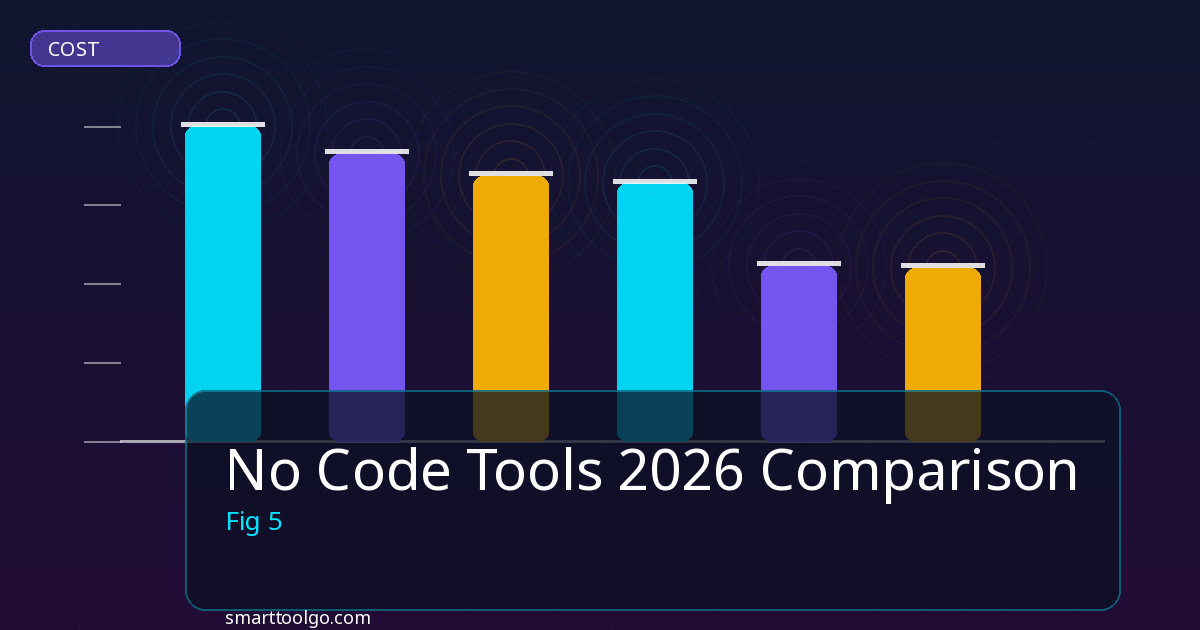
The key takeaway from the table: pricing models are not comparable at face value. Bubble and Softr bill by seat and feature tier largely independent of end-user count, while Budibase and (for team plans) Glide can multiply quickly per user. Match the model to your audience size.
Funnel yourself through the questions to get an honest starting point:
Run a two-day spike on the winner before committing. Build the ugliest possible version of your real app, then decide. The point of a spike is to surface platform lock-in and pricing surprises while they are still cheap to walk away from.
Every serious no-code project we shipped hit at least two of these costs late: custom domain and branding often sit a paid tier up; file storage and bandwidth cap out for media-heavy apps; and export/data portability is restricted on cheaper plans, meaning your database may not come with you if you leave. Read the export clause before you build, not when a client asks you to migrate. Budget also for one paid third-party plugin — the community marketplace is where half the feature depth actually lives, and free plugins are thin.
Be equally clear about the anti-patterns. Choose a traditional stack, or a low-code platform with real code escape hatches, when your app needs heavy concurrency, strict compliance audit trails, complex custom algorithms, or a high volume of sensitive data. No-code platforms trade raw control for speed. If your roadmap includes a real-time multiplayer feature or a proprietary scoring engine, you will fight the abstraction layer more than you benefit from it. The right test is not "can it be built" — it is "can it be built, maintained, and scaled by the team you actually have."
Before you commit to a stack, it pays to look at the developer side of the equation. Our AI code review tools guide helps you keep hand-written code clean if you go hybrid, and our AI code generator roundup covers the low-code middle ground. For traditional development workflows, see our code editor recommendations. To weigh no-code against the productivity toolbox surrounding it, read SmartToolGo's free productivity tools guide and . For Chinese-speaking readers, we also publish a code editor roundup in Chinese.
For more, check out: .
Bubble moved to workload-based pricing in 2026, so a high-traffic app costs more than a low-traffic one even on the same plan. Estimate by watching your monthly API calls and database operations during the free-tier trial, then project them to the Growth tier (~$134/mo annual) before committing. Apps with heavy polling or background processes are the ones that surprise.
Yes, but the cost scales with data complexity and custom logic. Spreadsheet-backed tools like Glide and Softr export data cleanly because your source is already Airtable or Sheets. Database-heavy tools like Bubble let you export data but not logic, so visual workflows must be rebuilt. Always keep an export of raw data from week one.
Not necessarily. Platforms like Bubble and Budibase include code escape hatches (plugins, functions or custom blocks), letting you keep 80% no-code and hand-write only the genuinely complex 20%. That hybrid is usually the best balance for mid-complexity products.
Budibase self-hosted is almost always the winner at that scale, since its per-user pricing only applies to managed cloud seats. Retool, by contrast, gets expensive fast per user at scale. Recompute at 300 users before signing anything.
A real but light project yes; a production, multi-user app no. Free tiers typically force subdomain hosting, cap data rows, and disable SSO and custom domains. Treat free tiers as evaluation sandboxes, not production hosting, and budget for the paid tier from day one.
Compare top-rated tools and read expert reviews on SmartToolGo.
Browse All Reviews →