Real-world data is expensive, messy, and increasingly locked behind privacy rules. If you have ever tried to train a model on medical records, financial transactions, or conversational logs, you already know the pain: yields inconsistent formats, labeling costs pile up, and privacy law makes sharing raw samples risky. A 2026 industry survey found that nearly half of ML teams now use some form of synthetic data, and the most cited reasons were privacy compliance and filling gaps in underrepresented classes. The catch is that synthetic data can silently poison a model if it does not match the real distribution. This guide gives you a concrete, step-by-step procedure for evaluating and adopting AI synthetic data tools without falling for the hype.
Step 1: Decide whether you actually need synthetic data
Not every data shortage is a synthetic-data problem. Before you license a generator, ask whether your real dataset is too small, too imbalanced, too sensitive, or simply too hard to collect. If you have plenty of clean labeled data, synthetic generation adds risk without adding much. The clearest wins are privacy-regulated domains where raw data cannot leave the building, plus rare-event classes, like fraud patterns or edge cases in autonomous driving, where real examples are vanishingly scarce. If neither applies, save your budget.
Step 2: Understand the two families of generation
Synthetic data tools split into two broad approaches, and choosing the wrong one wastes months. Rule-based generators use handcrafted logic to produce structured rows, ideal for obvious patterns like synthetic transactions or sensor logs with known constraints. Model-based generators train a generative model, such as a GAN or a diffusion model, on real data to produce samples that mimic the distribution, which is what you want for images, free text, and complex tabular data. The rule-based route is cheaper and more controllable; the model-based route captures nuance but risks memorizing real records, the exact privacy leak you are trying to avoid.
Step 3: Build a quality checklist before testing vendors
Vendor demos all look impressive, so bring a scoring rubric that focuses on measurable properties:
- Fidelity: Do generated samples match the statistical distribution and correlations of the real data?
- Privacy: Does the tool support differential privacy, and can it prove it does not regenerate exact real records?
- Coverage: Can you generate the rare or minority classes that your real data lacks?
- Schema control: Can you constrain formats, ranges, and relationships (like foreign keys) the way your ETL expects?
- Integration: Will the output drop directly into your existing data pipeline and model training loop?
Rate each candidate against these five axes with a simple 1–5 score. A tool that nails privacy but fails fidelity is as dangerous as one that looks realistic but leaks records.
Step 4: Compare the leading synthetic data platforms
Here is how the main tools compare on the checklist, based on their published capabilities and pricing for 2026:
| Platform / Tool | Key Features | Pricing |
|---|---|---|
| MOSTLY AI | Tabular synthetic data, differential privacy, statistical formats, Python SDK | Free Community tier; Team plans from ~$500/mo |
| Synthatic (formerly Hazy) | Tabular and time-series, on-prem deployment, GDPR-safe generation | Usage/quote-based, enterprise-focused |
| Gretel.ai | Data generation, anonymization, transformers for mixed data types | Free tier ($2 credits); paid from ~$600/mo running cost |
| MOSTLY AI vs Faker-style generators | Open-source rule-based libraries for simple structured dummy data | Free (Faker, Python) |
| Datagen | Photorealistic synthetic images for computer vision training | Quote-based, usage pricing |
| YData Fabric | Tabular and time-series synthesis, data quality profiling, connectors | Community tier free; Pro from ~$475/mo |
Notice the pattern: open-source rule-based libraries are free but only handle simple structured data, while model-based tools charge meaningful monthly fees because they burn GPU to train generative models. Start on the free tiers to validate the workflow before committing.
Step 5: Run your own before/after experiment
Do not judge a synthetic data tool on a static sample. Design a controlled experiment that tells you whether it helps your actual model:
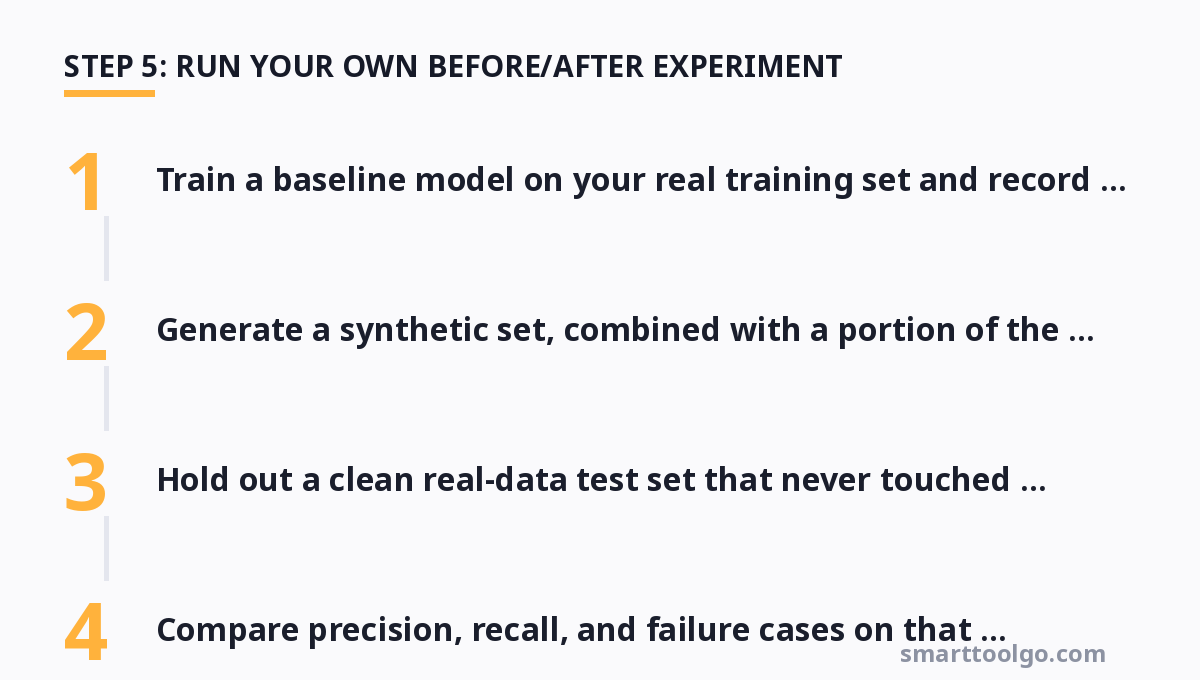
- Train a baseline model on your real training set and record its validation metrics.
- Generate a synthetic set, combined with a portion of the real data, and train a second model.
- Hold out a clean real-data test set that never touched generation.
- Compare precision, recall, and failure cases on that held-out set.
- Repeat with different synthetic-to-real ratios to find the blend that helps rather than hurts.
Teams that skip this step often find their synthetic-augmented models perform beautifully on synthetic-heavy validation and worse on real-world data. The held-out real test set is your only honest judge.
Step 6: Guard against the silent failure modes
The most dangerous synthetic data failures are quiet ones. Mode collapse, where the generator only produces a few repetitive patterns, inflates accuracy on training but collapses in production. Privacy memorization, where the model regurgitates exact real records, defeats the entire reason for using synthetic data. And correlation drift, where the model learns relationships that do not generalize, creates confident, wrong predictions. Mitigate these by checking for duplicate-like outputs, measuring privacy with actual membership tests, and validating statistical correlations on your held-out set before deployment. Document every generated dataset with its generator, seed, and quality metrics so you can trace issues back later.
Step 7: Plan the total cost, including the hidden ones
Synthetic data is not free even when the license is. GPU time for training generators, data science hours spent tuning and validating, and storage of large generated corpora all add up. A team that treats a $500-per-month tool as the whole budget will be surprised by the engineering effort to keep generated data in sync as the real data changes. As a rule of thumb, expect the non-license cost to equal or exceed the license once you include validation experiments and maintenance. Budget for recurring regeneration whenever your real distribution shifts, which in active products is constant.
For more, check out: .
Frequently asked questions
Will synthetic data fully replace real data in training?
Almost never in practice. The strongest results come from mixing synthetic data with at least a modest amount of real data, particularly for fine-tuning and validation. Pure-synthetic training risks distribution drift that only surfaces after deployment.
Does synthetic data actually protect privacy, or is it just marketing?
It protects privacy only if the tool enforces it rigorously, for example with differential privacy and tests for record memorization. A generator trained without those safeguards can leak exact real rows, so you need to verify the mechanism rather than trust the label.
Should I use a rule-based generator or a generative model?
Use rule-based generators for simple structured data with known constraints, and generative models for images, free text, and complex tabular distributions. Trying to model nuanced data with rules produces brittle samples, while training a model for trivial data is wasted compute.
Is open-source synthetic data generation a real alternative to paid tools?
For simple structured data, yes, free libraries work fine. For high-fidelity or privacy-critical synthesis, paid tools often justify the cost through differential privacy safeguards, better schema controls, and maintained connectors. Evaluate on your checklist, not on the price tag.
When is the ROI of synthetic data clearly positive?
When your model fails because of rare classes, privacy restrictions block data sharing, or labeling is the dominant cost. If your bottleneck is simply a small clean dataset with no privacy constraint, cheaper fixes like augmentation or transfer learning often come first.
Synthetic data is a powerful lever when used with discipline: validate on held-out real data, guard against quiet failure modes, and budget for the ongoing maintenance. To build a stronger foundation around your data work, start with our guide to data analysis tools, understand how to source real signals with data scrapers, and learn to extract insight from your data analysis workflows. For extra practical perspective on making the most of limited resources, see our take on and the broader free online productivity tools guide. Chinese-speaking readers can follow the companion Chinese-language data analysis software guide rundown.
Get one practical tool tip a week
Short, useful, no spam. Unsubscribe anytime.