
AI Recommendation Engines in 2026: How They Work, Options and What to Build
Published: 2026-08-03 | By Marcus Chow | Category: AI Tools | Updated: 2026-10-08
Every product with more than a few dozen items eventually needs a recommendation engine. Whether you are running an e-commerce store, a content platform, or a SaaS dashboard, the question is not whether to recommend — it is how much to invest, which approach to use, and how to know if it is actually working. This guide covers the practical decision tree for AI recommendation engines in 2026, from the simplest rule-based approaches to production-grade deep learning systems.
Why most recommendation systems fail at the business logic, not the model
The failure mode we see most often is not a bad model. It is a product team that spends three months building a collaborative filtering system, launches it, and then discovers that the recommended items are out of stock, unavailable in the user's region, or violate a pricing rule they never told the data team about. The model recommends a product the warehouse cannot ship. The product owner blames the algorithm. The algorithm was never the problem.
Before writing any model code, map out the business rules that constrain recommendations: inventory, availability, margin, compliance, and explicit user preferences. A rule-based system that correctly respects these constraints will outperform a sophisticated model that ignores them every single time. Start with the constraints, then add the model on top.
Six ways to build recommendations in 2026
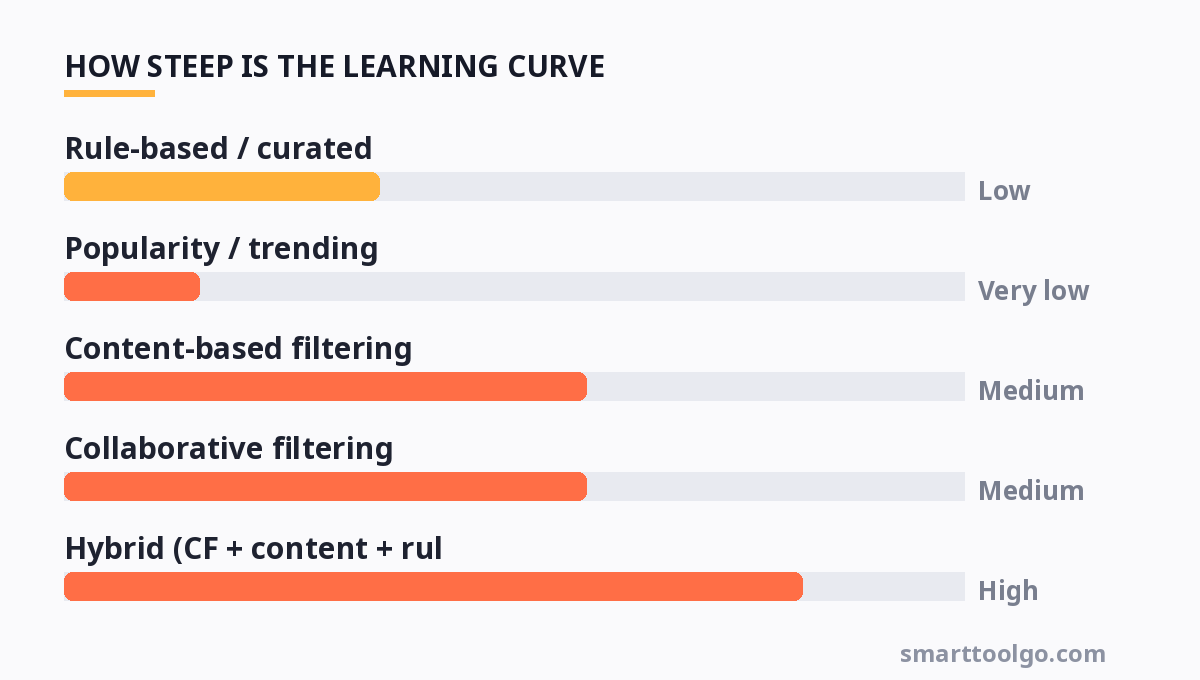
| Approach | Best For | Data Needed | Effort |
|---|---|---|---|
| Rule-based / curated | New products, small catalogs, editorial picks | None | Low |
| Popularity / trending | New users, cold start, content sites | Click counts | Very low |
| Content-based filtering | Catalogs with rich attributes (products, articles) | Item metadata | Medium |
| Collaborative filtering | Mature products with lots of user interaction data | Click/purchase history | Medium |
| Hybrid (CF + content + rules) | Production e-commerce and content platforms | Interaction + metadata | High |
| LLM-powered recs | Niche catalogs, natural language queries, 2026-era startups | Item descriptions | Medium |
For most teams, the right path is: start with popularity and curated picks, add content-based filtering once you have item metadata, and only introduce collaborative filtering after you have at least a few thousand user interactions. LLM-powered recommendations (using embeddings from OpenAI, Cohere, or open-source models) have lowered the barrier dramatically in 2025-2026 — you can generate semantic similarity between items with a few hundred lines of Python and no training data.
Cold start is the place most projects quietly die
Cold start means: you have a new user, or a new item, and the system has no data to recommend from. New users get the generic homepage. New items get no exposure. Over time, this creates a bias toward already-popular items and a graveyard of good content nobody sees.
The practical fixes: for new users, use onboarding preferences (category, use case) to seed content-based recommendations. For new items, give them a temporary popularity boost — a "new arrivals" section that guarantees exposure for the first two weeks. For brand-new products with no interaction data at all, use content-based filtering on the item's attributes (category, price, tags) to find similar existing items and recommend alongside them. This is not glamorous, but it works.
There is a subtler cold start problem that nobody talks about: the cold start of categories. When you add a new category to your store — say you started selling books and now add electronics — your collaborative filtering model has no cross-category interaction data. A user who bought three Python books gets recommended more Python books, not the Raspberry Pi kit they would actually buy. The fix here is hybrid: use content-based filtering across categories (both books and electronics have tags) combined with a temporary popularity boost for the new category. Over time, as users interact with the new category, the collaborative filtering model kicks in and takes over.
For B2B products with long sales cycles (30-90 days), the cold start problem is different: you may not have enough conversions to train a model that predicts purchase intent. In this case, use click-through and time-on-page signals as proxies for intent, and combine them with firmographic data (company size, industry, role). A visitor from a Fortune 500 company who spends 5 minutes on your pricing page is a much stronger signal than a college student who clicks a link and bounces in 3 seconds.
Evaluation is the part nobody budgets for
You cannot improve what you do not measure. The minimum evaluation stack for a recommendation system includes: offline metrics (precision, recall, NDCG on held-out interaction data), online A/B tests (click-through rate, conversion rate, revenue per session), and qualitative spot checks (a human looks at the recommendations and says "these make sense").
A common trap is optimizing only for click-through rate. Recommendations that maximize clicks often surface clickbait — sensational, low-quality items that get the click but not the purchase. Track the downstream metrics that matter: conversion rate, average order value, and retention. A recommendation that gets fewer clicks but higher conversion is winning.
Offline evaluation has its own traps. The standard precision/recall/NDCG on held-out interaction data sounds rigorous but has a known flaw: it measures how well you can predict what users already clicked, not whether those clicks were good. A model that recommends popular items will score well on offline metrics and do nothing for your business. The only evaluation that matters is the online A/B test: half your users see the old recommendations, half see the new, and you compare the revenue-per-session or retention difference. Run it for at least two weeks — day-of-week and weekend effects are huge.
Qualitative spot checks are cheaper and more revealing than they sound. Every week, pick 10 random users and look at what the system recommended. If you find yourself thinking "why would anyone recommend this to that user?" — and you will — you have found a segment the model is failing on. Write that case up as a test, fix the underlying data or rule, and add it to your regression set. Over a few months, this catches problems that no automated metric will flag.
The data reality check before you commit
Before investing in a recommendation system, ask three questions. First: how many items do you have? Under 50? Curated picks are fine. Over 10,000? You need automation. Second: how much interaction data do you have? Under 1,000 events? Collaborative filtering will not work yet — start with content-based. Third: what is the cost of a bad recommendation? If it is a content site, a bad recommendation costs a click. If it is medical or financial, a bad recommendation costs trust — invest in human curation and conservative algorithms.
LLM-powered recommendations in 2026
The biggest shift in recommendation systems over the past two years is that you no longer need a data science team to build a semantic recommendation engine. Using embedding models (OpenAI text-embedding-3, Cohere Embed, or open-source models like BGE-M3), you can compute a vector for each item's description, then find the nearest neighbors in vector space. This gives you content-based recommendations that understand meaning, not just keyword overlap — "wireless headphones" and "Bluetooth earbuds" become similar even though they share no words.
The practical stack: store item embeddings in a vector database (Pinecone, Chroma, or even a PostgreSQL extension like pgvector), compute the embedding for each new item when it is created, and at recommendation time find the nearest neighbors to the user's recently viewed items. This is a few hundred lines of code, no training pipeline, and it works surprisingly well for catalogs up to tens of thousands of items. It is not a replacement for collaborative filtering at scale, but it is the right starting point for 90% of products.
The 2026 twist is that you can now use LLMs directly as recommenders, not just as embedding generators. Given a user's last five viewed items, ask GPT-4o or Claude: "Given this user has looked at these five products, what are three products they might be interested in, and why?" This works shockingly well for niche catalogs where you know the items well — the LLM reasons about use cases and combinations that vector similarity alone would miss. It is more expensive per call, but for high-value B2B products where one conversion pays for thousands of recommendations, it is worth testing. Start with a small A/B test: 5% of traffic gets LLM recommendations, measure conversion, and scale up only if it wins.
One caution: LLMs hallucinate product names. If you use an LLM to generate recommendations, constrain it to your actual catalog — either by passing the catalog in context or by generating a search query that hits your own product database. Never let the LLM return a product name that does not exist in your catalog.
Privacy and compliance: recommendations are not a free pass
Recommendation systems rely on user data, and that brings regulatory constraints. In the EU, GDPR gives users the right to object to automated decision-making and profiling. In California, CCPA gives users the right to opt out of the sale of their personal information. If your recommendations rely on tracking across sites or apps, you need consent banners and opt-out mechanisms. If you only use first-party data collected on your own site (what the user browsed while on your site), the compliance burden is much lighter — but you still need a privacy policy that explains what you track and why.
The practical rule: build your recommendation system so that it works without cross-site tracking. Use only first-party interaction data. Give users a visible "recommendations powered by your browsing" disclosure. Honor DNT (do-not-track) signals and opt-out requests by falling back to popularity-based recommendations. This is not just about compliance — it is about trust. Users who know you are not selling their data are more likely to browse freely, which actually improves your recommendations.
Common anti-patterns that quietly hurt performance
Anti-pattern 1: Filter bubbles. A recommendation system that only shows users what they already like creates a closed loop. Discovery drops. Users get bored. The fix: deliberately add 10-20% exploration — items the user has not seen but that fit a broader category. This is the explore-exploit tradeoff, and ignoring it is the most common long-term failure mode of recommendation systems.
Anti-pattern 2: Too many recommendations. A homepage with 20 recommendation carousels is a homepage nobody scrolls. Fewer, better recommendation blocks outperform more, generic ones. Two blocks (one "based on your browsing," one "trending now") is usually enough. Each block should have 6-12 items max.
Anti-pattern 3: Ignoring seasonality and context. A recommendation engine trained on all-time data will keep recommending winter coats in July. Add time-based signals: recent interactions matter more than year-old ones. If your product has seasonal patterns (holidays, back-to-school, tax season), weight those explicitly. Contextual signals — device type, time of day, weather — can also change what you recommend: a phone recommendation on a phone browser should be different from the same user on a desktop.
Frequently Asked Questions
How much does it cost to build a recommendation engine?
A rule-based or popularity-based system costs almost nothing — it is a few SQL queries. A content-based system using LLM embeddings costs a few hundred dollars a month in API and vector database fees. A production collaborative filtering system with a data science team costs tens of thousands of dollars a month. Most products are better off starting small and scaling only when the data justifies it.
Do I need a machine learning team for recommendations?
No. For most products, off-the-shelf tools (Algolia Recommend, Clerk.io, Nosto) or a simple LLM-embedding setup in-house will outperform a half-built custom model. Hire ML help only when you have a data volume and a business case that justify it — typically after a few million interactions and a clear revenue gap.
How do I handle users who opt out of personalization?
Serve them popularity-based or curated recommendations. Personalization is a bonus, not a requirement for a working recommendation system. Make sure your fallback recommendations are good — they will be what logged-out and opted-out users see, and that is most of your traffic.
How often should recommendations be updated?
For most products, daily recomputation is enough. Popularity and trending data can refresh hourly. Real-time updates (session-based recommendations) matter for high-traffic e-commerce but are overkill for content sites. Start with daily and move to hourly only if users stay on the site long enough for recommendations to feel stale during a session.
Should I build or buy a recommendation engine?
For products under $10M in revenue, buy. Off-the-shelf tools like Algolia Recommend, Clerk.io, Nosto, and Dynamic Yield handle the engineering and let you focus on content and merchandising. Building in-house makes sense only when (a) you have a data science team, (b) your recommendation logic is a competitive differentiator, or (c) you have unusual data that off-the-shelf tools cannot handle. The build-vs-buy threshold is higher than most founders think — most in-house recommendation projects take 6-12 months and never match the off-the-shelf alternative.
What metrics should I put on my dashboard?
The five that matter: recommendation click-through rate, recommendation-attributed conversion rate, revenue per recommendation impression, diversity (how many unique items get recommended per week), and coverage (what percentage of your catalog appears in at least one recommendation). Diversity and coverage are the most neglected — they tell you whether your system is hiding 90% of your catalog behind the same 20 popular items. If coverage is below 50%, your long-tail products are invisible no matter how good your model is.